
Import Cashew Nuts to United States
The United States ranks among the world's largest consumers of cashew nuts, driven by strong retail snack demand, food manufacturing applications, and ingredient use across bakery, confectionery, and plant-based product categories. Importing cashew nuts into the United States requires structured regulatory compliance, accurate documentation, and consistent adherence to federal food safety standards.
Cashew imports are regulated under federal food safety law and customs procedures. Importers must ensure proper facility registration, preventive control measures, accurate documentation, and alignment with inspection protocols to avoid shipment delays, detention, or rejection.
This page explains the regulatory framework, documentation requirements, inspection processes, quality standards, and risk management considerations involved in importing cashew nuts into the U.S. market.
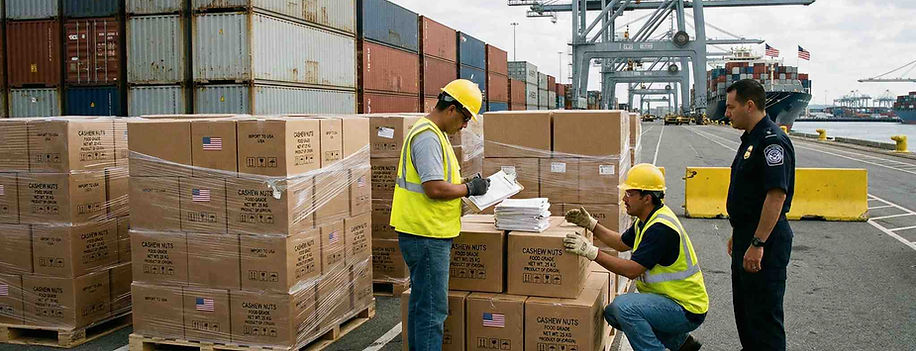
U.S. Regulatory Framework for Cashew Nut Imports
Cashew nuts imported into the United States are regulated primarily by the Food and Drug Administration (FDA) and monitored at entry by U.S. Customs and Border Protection (CBP).
The regulatory system is built around food safety compliance, importer accountability, risk-based inspection, preventive controls, and traceability requirements. All food imports, including cashew nuts, are subject to screening under U.S. food safety laws. Compliance failures can result in detention, laboratory testing, or refusal of entry.
FDA Requirements for Importing Cashew Nuts
1. Facility Registration
Foreign manufacturers and processors handling cashew nuts destined for the U.S. must be registered with the FDA. Failure to register can result in automatic shipment refusal.
2. Foreign Supplier Verification Program (FSVP)
Importers are responsible for verifying that their foreign suppliers comply with U.S. food safety standards. This obligation encompasses hazard analysis, preventive control evaluation, supplier performance review, and corrective action documentation. The importer of record must demonstrate active oversight of supplier food safety controls.
3. Preventive Controls and Hazard Analysis
Cashew nuts must be produced under preventive control systems that address hazards including aflatoxin contamination, microbial risks, physical contamination, and cross-contact risks. Importers may be required to provide documentation supporting their hazard control procedures.
Aflatoxin and Contaminant Control in U.S. Cashew Imports
Aflatoxin contamination represents one of the most significant compliance risks in cashew nut imports. The FDA monitors aflatoxin levels in nuts, including cashews, and shipments may be sampled at port for laboratory testing.
Factors that increase the likelihood of inspection include high-risk origin history, incomplete documentation, prior detention records, and inconsistent laboratory reports. To reduce exposure, importers typically require pre-shipment testing by accredited laboratories, batch-level traceability, and clear moisture control documentation.
Pesticide Residue Compliance
Cashew nuts must comply with U.S. pesticide residue tolerances. Non-compliant shipments may be refused entry or subject to reconditioning requirements.
U.S. Customs and Border Protection Procedures
All cashew imports must be properly declared to U.S. Customs and Border Protection (CBP).
Entry Filing
Importers must submit a commercial invoice, packing list, bill of lading, entry summary, and importer of record details.
Prior Notice Submission
FDA prior notice must be filed before the shipment arrives in the United States. Missing or incorrect prior notice can result in automatic detention.
Inspection Triggers
Shipments may be flagged for random inspection, risk-based screening, laboratory sampling, or documentation review. Clear and consistent paperwork significantly reduces the risk of inspection delays.
HS Code and Classification for Cashew Nuts in the United States
Accurate classification under the Harmonized Tariff Schedule is essential for proper duty assessment and customs clearance. Cashew nuts may be classified differently depending on whether they are raw or processed, presented as whole kernels or broken pieces, or sold as flavored or prepared products. Misclassification can lead to additional duty assessments, delayed clearance, and increased scrutiny. Professional importers confirm HS classification prior to shipment dispatch.
Quality and Grading Expectations in the U.S. Market
The U.S. market demands consistent quality and grading standards for cashew imports.
Kernel Grades
Common grades include W180, W240, W320, W450, splits, and pieces. Retail markets typically demand premium whole grades, while industrial buyers may accept mixed grades depending on their application.
Moisture Levels
Moisture control is critical to preventing mold development and quality deterioration. Excess moisture also increases aflatoxin risk and should be addressed at origin.
Defect Tolerances
Contracts typically define acceptable thresholds for broken kernels, discoloration, foreign material, and insect damage. Clear grade alignment at the point of purchase helps prevent disputes upon arrival at destination.
Packaging, Labeling, and Storage Requirements
Packaging Standards
Cashew nuts imported into the U.S. are commonly packed in food-grade cartons, vacuum-sealed bags, and moisture-resistant liners. Packaging must protect against humidity and pest exposure throughout transit.
Labeling Compliance
Labeling must align with U.S. food labeling laws. Depending on the distribution format, labeling may include product identity, net weight, country of origin, and allergen statements. Incorrect labeling can delay customs clearance or retail distribution.
Storage and Handling
Improper storage increases the risk of mold development, insect infestation, and quality degradation. Importers typically implement warehouse inspection protocols to maintain compliance after arrival.
Major U.S. Ports of Entry for Cashew Imports
Cashew nuts enter the United States through several major ports, including Los Angeles, New York/New Jersey, Houston, and Savannah. Inspection intensity may vary by port and shipment risk profile. Delays may occur when laboratory sampling is required.
Common Risks in U.S. Cashew Nut Imports
Professional importers actively manage risks such as FDA detention due to incomplete documentation, missing prior notice filings, aflatoxin exceedance, pesticide residue violations, incorrect HS classification, label non-compliance, and supplier registration issues. Preventive risk management reduces operational disruption and protects supply continuity.
U.S. Market Overview for Cashew Nuts
The United States maintains strong demand for cashew nuts across retail snack markets, private-label grocery brands, bakery and confectionery manufacturers, nut butter production, and food service and hospitality sectors. Consumer preference for plant-based protein and healthy snacking continues to support cashew consumption growth.
Importers supplying the U.S. market must balance price competitiveness, grade consistency, regulatory compliance, and reliable logistics execution.
How Agriprime Supports Cashew Imports to the United States
Agriprime operates as a B2B agro-commodity broker and import coordination partner supporting structured cashew import programs. For U.S. cashew imports, Agriprime supports supplier qualification and origin verification, pre-shipment laboratory testing coordination, specification alignment and grade verification, documentation review prior to dispatch, and compliance-focused import execution. The objective is to reduce regulatory risk, prevent detention, and ensure shipment reliability for professional buyers.
Import Cashew Nuts to United States – Structured Process Overview
A structured import program typically includes supplier qualification and compliance review, specification alignment with U.S. buyer standards, pre-shipment laboratory testing, accurate documentation preparation, prior notice submission, customs filing and clearance coordination, and post-arrival inspection and storage management. Each stage reduces regulatory exposure and improves supply chain stability.
Start Your Cashew Nut Import Inquiry for the U.S.
Importers planning to source cashew nuts for the U.S. market should define their intended application (retail, processing, or wholesale), preferred grades and formats, estimated shipment frequency, required certifications, and applicable regulatory constraints. Professional import execution ensures compliance with FDA and customs requirements while maintaining consistent product quality.
Final Considerations for U.S. Cashew Imports
Importing cashew nuts into the United States is a regulated process that requires coordination across supplier verification, preventive food safety controls, documentation accuracy, customs compliance, and logistics management. Buyers who prioritize structured compliance, traceability, and risk mitigation are better positioned to maintain uninterrupted supply and protect their commercial reputation.